
| BIOGRAPHY |
| Biography | Timeline | Bibliography | Further Reading |
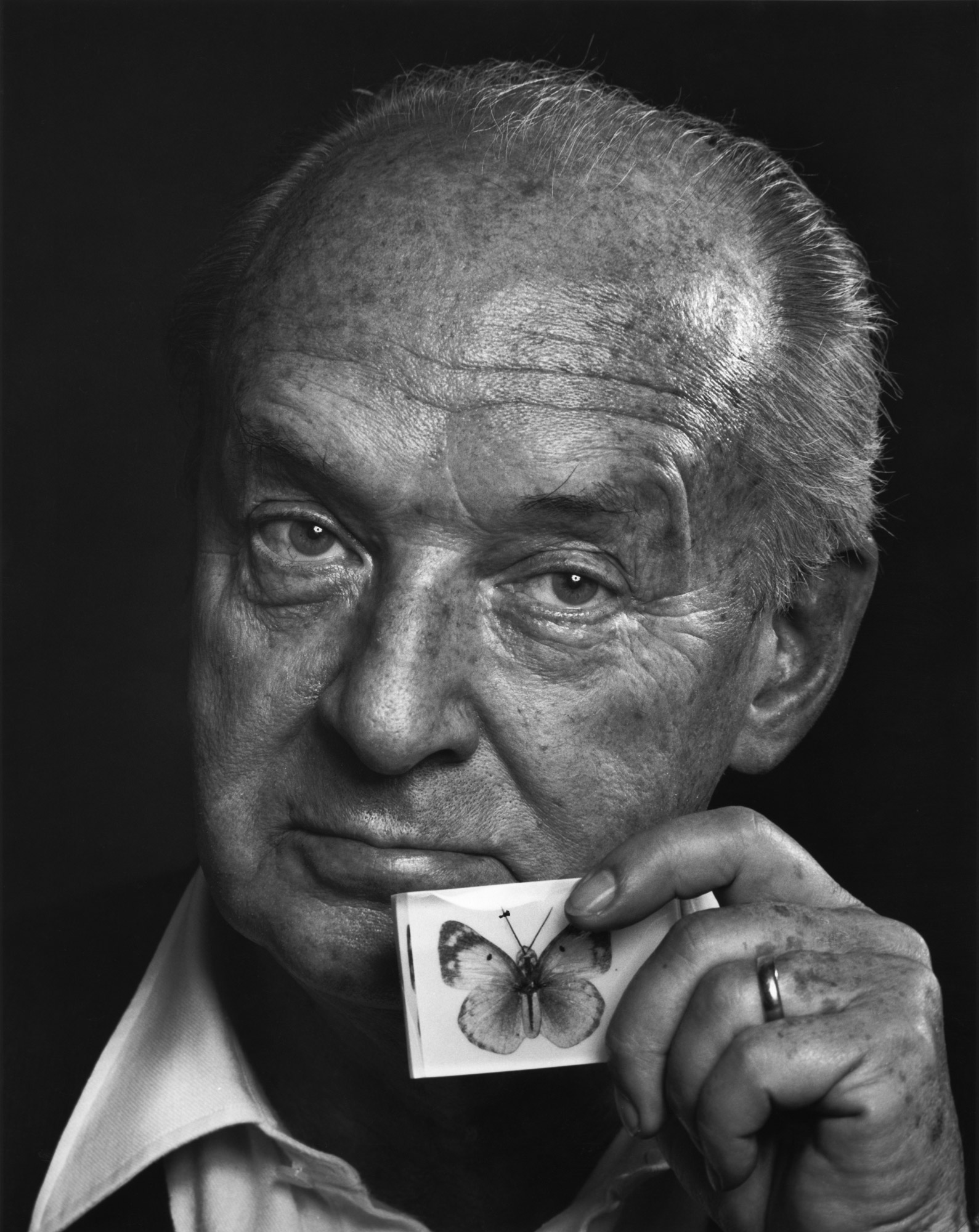 |
Vladimir Nabokov (Vladimir Vladimirovich Nabokov)
Владимир Набоков |
|||
| Born | 10 April 22, 1899
St. Petersburg, Russia |
|||
| Died | July 2, 1977
Montreux, Switzerland |
|||
| Education | Trinity College, Cambridge
|
|||
| Family | Spouse: Véra Nabokov (Married: 1925)
Children: Dmitri Nabokov |
|||
| Signature |  |
|||
| Biography | ||
| Contents | 1. Who’s Who in the Twentieth Century. Oxford University Press, 2003
2. The Cambridge Companion to American Novelists. Cambridge University Press, 2013
|
|
| 1. Who’s Who in the Twentieth Century | Russian-born US novelist.
Born in St Petersburg,Nabokov left Russia with his aristocratic family in 1919, having already published two verse collections (1916 and 1918). In England he became a student of zoology at Trinity College, Cambridge, but later switched to literature. While in England he wrote two further volumes of Russian poetry, published in 1923. From 1922 to 1940 Nabokov lived in Germany and France, establishing himself as an émigré writer of Russian novels with Mashenka (1926; translated 1970), an autobiographical love story, and Korol-dama-valet (1929; translated as King, Queen, Knave, 1928). Subsequent works included his chess novel Zashchita luzhina (‘The Luzhin Defence’, 1930; called The Defence in the 1964 English translation), Camera Obscura (1933; translated 1936 and called Laughter in the Dark in the 1938 US translation), and Priglasheniye na kazn (1935; translated as Invitation to a Beheading, 1959). The last of his Russian novels, Dar (1937; translated as The Gift, 1963), introduced his mastery of literary parody of which he was to make skilful use in his later English books. All these Russian-language novels were published under the pseudonym V. Sirin, derived from the name of an admired Russian publisher.
In 1940 the penurious Russian émigré moved with his wife Véra and son Dimitri to the USA; here he established himself as a teacher of Russian subjects at a variety of colleges, became a US citizen in 1945, and in 1948 settled down for eleven years as professor of Russian literature at Cornell University. In this period he wrote under his own name in a consummately polished English that gave no hint of being a second language. The first of his English novels, The Real Life of Sebastian Knight (1941), was followed by Bend Sinister (1947) and Pnin (1957), a portrait of the New World as seen through the lugubrious eyes of an Old-World émigré professor of entomology. The contrast between the brash new and the intellectual old is again the theme of Lolita (1958; Paris publication 1955), a hilarious and highly sophisticated account of a middle-aged European's physical obsession with a monstrous twelve-year old American girl. As pornography, Lolita brought Nabokov instant notoriety and considerable wealth. As allegorical literature, he had to wait a little longer for acclaim and for the interest that it awakened in his earlier (and later) work. Most notable of his novels after Lolita are Pale Fire (1962), written in the form of a long poem accompanied by a parody of a critical commentary, and Ada: A Family Chronicle (1969), a long and sensual novel written in his uniquely erudite style. Apart from his eighteen papers on entomological subjects (he was an ardent amateur lepidopterist), Nabokov wrote an autobiography, Speak, Memory (1967), a translation of Alice in Wonderland into Russian (1923), and a translation of Eugene Onegin (1964) into English.
|
|
| 2. The Cambridge Companion to American Novelists | "I am as American as April in Arizona.”’ With this affirmation in 1966, Vladimir Nabokov (1899-1977) both declared his firm allegiance to the country to which he had emigrated in May 1940 and displayed a salient feature of his verbal art: his creative approach to language and his fondness for rejuvenating dead cliches (“American as apple pie”). Yet he also declared in 1966 that “the writer’s art is his real passport” (SO, 63), and one senses that as he matured as a writer of English-language fiction, Nabokov sought to promote a synthesis of the best of Russian, European, and Anglo-American literary traditions. Indeed, in answering a question about national identity in 1964, Nabokov touched upon the many places he had lived (and the many cultures he had experienced): “I am an American writer, born in Russia and educated in England where I studied French literature, before spending fifteen years in Germany” (SO, 2.6). In his best work he combines vividly observed details about personalities and settings with allusive references to a range of literary material, from medieval Russian epics to French symbolism to the latest manifestations of popular culture.
Nabokov had been a leading figure in the Russian emigre literary community (having published eight novels, more than forty short stories, and dozens of poems) when he arrived in the United States. Now he was faced both with the daunting prospect of reinventing himself as a writer in English and the more immediate task of trying to support himself, his wife, and his young son in a new country. Initially, he had to rely on charity and on private language instruction. Over time, he began publishing book reviews in the New Republic and short stories and poems in the Atlantic Monthly. He taught summer courses at Stanford in 1941 and obtained a part-time position as a lecturer at Wellesley College that eventually became a full-time position, with courses on literature and on the Russian language. He also worked at the Museum of Comparative Zoology at Harvard University, researching and cataloging butterflies. The early 1940s were a time of firsts for Nabokov: his first poem to be published in the New Yorker (“A Literary Dinner,” April 6, 1942.); his first short story written in English, “The Assistant Producer” (Atlantic Monthly, May 1943); and most significantly, his first English-language novel, The Real Life of Sebastian Knight (1941). Already aware in the late 1930s that prospects for maintaining a viable career as a Russian-language writer were waning, Nabokov had decided to try writing fiction in English. He composed the novel in late 1938 and early 1939 while still living in France, but the book awaited Nabokov’s arrival in America to find a publisher. Nabokov had learned English as a child and had become proficient in the language while at Cambridge, but the task of composing an original novel in English was nonetheless challenging. He chose as his topic favorite themes: the creative life of a writer and the problem of composing a biography uncontaminated with the biographer’s own projections. V, the narrator of the novel, seeks to retrace the life of his half brother, the writer Sebastian Knight, who had an English mother and a Russian father. This quest leads him into experiences that surprisingly overlap and interlace with his brother’s prior experiences. Eventually V believes that Sebastian’s spirit is guiding his quest and that he has come to know Sebastian’s soul so well that he seems to merge with Sebastian: “I am Sebastian, or Sebastian is I, or perhaps we both are someone whom neither of us knows.”2 Nabokov’s first effort at an English-language novel shows remarkable complexity and subtlety, and it hints at the prominence of certain elements in his later work, including the plight of the gifted individual adrift in an alien environment and the magic of multilingual virtuosity. Nabokov’s second English-language novel, and his first to be composed in America, conveys a very different mood. Bend Sinister, published in 1947, reflects the oppressive strains of twentieth-century totalitarianism. Set in an imaginary country with features reminiscent of Nazi Germany and Stalinist Russia, the novel centers on the perceptions of a philosopher named Adam Krug, who is overwhelmed by the recent death of his beloved wife, Olga. Blinded by his grief, Krug fails to comprehend the tide of tyranny rising around him as the Party of the Average Man, led by Krug’s old schoolmate Paduk, tightens its grip on the land. It is only when Paduk, in an effort to secure Krug’s endorsement for his policies, seizes Krug’s son, David, that Krug begins to acknowledge what is truly transpiring. Now ready to sign any document to save his son, Krug is horrified to learn that his son has been killed in an experiment the regime conducted with violent criminals. Krug goes numb with shock, and the narrator-creator of the novel spares Krug from further pain by sliding toward him in his prison cell along a beam of pale light, “causing instantaneous madness” but saving him “from the senseless agony of his senseless fate.”3 The narrator subsequently rescues Krug from imminent death by getting up from his writing desk to investigate the sound of a moth hitting a window screen. With this metafictional twist, Nabokov advocates for the power of the individual creative consciousness and the importance of pity in the face of blunt tyranny. Still, the very style of Bend Sinister reflects Krug’s predicament as it evinces a sense of exhaustion, almost as if its narrative consciousness is too tired or distraught to provide complete descriptions or maintain a consistent tone. Unable to secure a permanent position at Wellesley, Nabokov moved to Ithaca, New York, in July 1948, to begin a teaching career at Cornell University. In the same year, the New Yorker published “Symbols and Signs,” one of the best short stories Nabokov wrote in English (and better known under its original title, “Signs and Symbols”). The story provides a haunting depiction of an elderly emigre couple’s anxiety over the fate of their son, a young man institutionalized in a mental hospital because of “referential mania,” the belief that everything in his environment contains “a veiled reference to his personality and existence.”4 The story itself is replete with images that lead the reader to imagine the boy’s destiny: will he succeed in his attempts at suicide, or will his parents save him? This story, along with “The Vane Sisters” (written in 1951 and published in 1958), stands as one of the finest examples of Nabokov’s short American fiction. The latter tale is also richly allusive, and its ending contains a message that is often missed by the first-time reader: the first letters of the words in the final paragraph form an acrostic transmitting a communication from one of the dead sisters to the self-centered and uncomprehending narrator. In 1951, Nabokov published the first version of his autobiographical memoir. Originally entitled Conclusive Evidence, the work was translated into Russian, expanded, and published in 1954 under the title Drugie berega [Other Shores). Nabokov then revised the memoir once again and published it anew as Speak, Memory in January 1967. Focusing on his childhood and youth, and to a lesser degree on his experiences in Western Europe, the memoir offers a highly lyrical treatment of Nabokov’s growing enchantment with the surrounding world. Treating his life somewhat as a literary work, the writer identifies and traces “themes” in his past, and the reader senses the author’s desire to overcome the limitations of linear time with its inevitable losses. While teaching at Cornell, Nabokov also began working on what would turn out to be his most famous novel - Lolita (1955). Originally entitled The Kingdom by the Sea, this account of a thirty-seven-year-old man’s obsession with a twelve-year-old girl forms one of the most compelling novels of the twentieth century. In many respects, this is Nabokov’s most “American” novel, and he conducted extensive research in preparation for its creation. As he was to write in his essay “On a Book Entitled Lolita” it had taken him forty years to “invent Russia and Western Europe, and now he was “faced with the task of inventing America."5 He studied such things as the physical development and speech patterns of pubescent girls, the workings of American handguns, and the titles of popular music recordings, and he added to this his own vivid observations of the realia of American life gathered while on his summertime trips across the United States in search of rare butterflies and invigorating landscapes. At times he felt the task to be so daunting that he despaired of its success, and his wife, Vera, had to intervene to prevent him from burning the manuscript in their backyard incinerator. Finally, however, the work was complete, and Nabokov tried to find a publisher who would take it on. Rebuffed by five American publishers, Nabokov turned to a French agent to see whether the work could be published abroad. The agent found Maurice Girodias, the owner of Olympia Press, who gladly accepted the assignment. Unbeknown to Nabokov, among the works Girodias published were pornographic novels for English-speaking travelers. Girodias saw no problem with Lolita, and rhe novel appeared in two volumes in 1955. It might well have languished in obscurity were it not for the fact that Graham Greene proclaimed it one of the best books of the vear in the Christmas edition of the London Sunday Times. This in turn provoked a harsh rebuttal m the London press by one John (Jordon, and a spirited controversy soon erupted. Publishers in the United States grew interested, and Lolita was finally published in New York in August 1958. Within a month, it had reached the top of the best seller list, and it remained there for seven weeks. Lolita presents an extraordinary blend of lyricism, humor, and pulsing pathos. 1 he narrator, who calls himself “Humbert Humbert," is an urbane, witty European, whose breezy chatter has often seduced readers into finding him a sympathetic and even “touching figure (SO, 94). Humbert is profuse and eloquent in Ins profession of love for Dolly (as in the famous opening phrase: “Lolita, light of my life” [Lo, 91]), and he is scathing in his criticism of those he regards as standing between him and the girl, including her mother, Charlotte. Yet those readers who may find themselves momentarily charmed by a clever turn of phrase or sharp observation then become dismayed when thev realize thev have been sympathizing with a man who has subjected a defenseless girl to a relentless regime of physical and mental abuse This realization arises in moments of penetrating lucidity (for Humbert and the reader alike), such as when Humbert summarizes the tenor of his first cross country trip with Dolly: And I catch myse t un mg today that our long journey had only defiled with a sinuous trad of slime the lovely, trustful, dreamy, enormous country that by then ... was no more to us than a collection of dog-eared maps, ruined tour books ... and her sobs in the night - every night, every night - the moment I feigned sleep” (Lo, 176). The critical reaction to the novel has been extensive and varied. Many early critics sided with Humbert and took a dim view of Dolly Haze (Dorothy Parker, tor one, called Dolly “a dreadful little creature, selfish, hard, vulgar, and foul-tempered”).6 Indeed, the very term “nymphet” that Humbert uses to describe girls he is attracted to has come to mean in popular usage a sexually precocious and provocative girl. Yet later critics challenged this view and began to see in Dolly a plucky child striving mightily to establish a semblance ot normalcy in a life that has been anything but normal. Critics have also debated the moral tenor of Nabokovs novel. Citing Nabokov’s assertion in “On a Book Entitled Lolita" that Lolita “has no moral in tow” (Lo, 314), some have readily concluded that the novel is amoral, if not downright immoral. Yet in the same passage Nabokov writes that for him, a work of fiction exists only insofar as it affords him what he calls “aesthetic bliss, that is a sense of being somehow, somewhere connected with other states of being where art (curiosity, tenderness, kindness, ecstasy) is the norm” (Lo, 314-15). One should note that two of the qualities associated with “art” arc tenderness and kindness, and these qualities have, in Nabokov’s creative world, a definite ethical and moral content. Nabokov does not deny the importance of morality in art; he simply rejects works that preach to their readership, proffering an easily detachable moral message. In fact, Lolita is a highly moral piece of fiction in that every page confronts the reader with moral and ethical issues that the reader, as well as Humbert, may ponder. In addition to debating the issue of morality in Lolita, some critics perceived that Humbert’s acerbic depiction of American mores implied that his creator held a condescending view of his adopted country as well. Nabokov strenuously objected to this conclusion. Addressing the question of whether Lolita is “un-American," Nabokov lamented: “This is something that pains me considerably more than the idiotic accusation of immorality.... Humbert is a foreigner and an anarchist, and there are many things, besides nymphets, in which I disagree with him" (Lo, 315). The significant disparity between the narrator’s and the author’s perspectives in Lolita also plays an important role in Nabokov’s next novel, Pnin. Several chapters of Pnin were published in the New Yorker from 1953 to 1955, but the full version of the novel only appeared in 1957. Pnin may well be Nabokov’s most “accessible" English-language novel, and it focuses on the travails of a Russian emigre trying to secure a permanent position as an instructor at “Waindell College." One of Nabokov's most endearing creations, Pnin appears to be comically inept in his efforts at coping with his environment. Although the narrator of the novel (who remains in the background for most of the tale) seems to be trying to depict Pnin as a figure of tun, the sensitive reader recognizes that Pnin possesses an enormous capacity for tenderness and compassion - for a stray dog, a thirsty squirrel, and other peoples’ suffering. Pnin’s own attempts to find security in the present are highlighted by the reader’s awareness of the losses he has suffered in the past, including the gruesome death of an early love, Mira Belochkin, in a Nazi extermination camp. Yet Nabokov’s treatment of the character suggests that Pnin’s life has been touched by something akin to magic, particularly after the visit of Victor Wind, the son of Pnin’s ex-wife, Liza. In the final chapter of the novel, the narrator suddenly emerges in the foreground, arriving at Waindell to take up a teaching position that Pnin can never attain. It turns out that the narrator was Liza’s lover before she married Pnin, and although the narrator wishes to make contact with Pnin, the latter escapes the narrator's reach, and at the end of the novel, Pnin is shown driving off along a shiny road “where there was simply no saying what miracle might happen.”7 Pnin resurfaces as a minor (and less attractive) character in Nabokov’s next novel. Pale Fire (1962). With this novel, Nabokov moves further into multinational or transnational literary terrain. The novel ostensibly focuses on a long narrative poem by an American poet, John Shade, and it includes a commentary written by Shade's neighbor, Charles Kinbote. Kinbote’s commentary, however, comes to dominate the novel. Over the course of the commentary, Kinbote transforms Shade's poem, with its delicate meditations on death and on the loss of his daughter, Hazel, to suicide, into a coded depiction of the fabulous kingdom of Zembla (whose language combines Slavic and Germanic elements), the deposed king of which, the reader soon surmises, is none other than Kinbote himself. The situation in which a voluble commentator appropriates for his own purposes the narrative poem for which he is supposed to be providing scholarly commentary surely reflects a parodic version of Nabokovs own experience providing a translation of and multi volume commentary on one of Russian literature s greatest achievements - Alexander Pushkin's novel in verse Eugene Onegin (the four-volume Nabokov edition appeared in 1964k Yet the novel also touches upon some of Nabokov's most cherished themes, such as the question of whether the life of an individual comes to an end with death, or whether something of the individual spirit survives, perhaps to overcome time and space and the loss of life, loved ones, and homeland. At first glance, Kinbote’s odd ramblings seem to have little relation to Shade’s carefully constructed poem, but as one reads the poem and commentary more closely, numerous interconnections anti points of contact swim into view. These links have led some commentators to identify one or the other of the two main figures as the creator of the other, and indeed, standing behind the figure of Charles Kinbote seems to be another character, a professor named V Botkin. (Behind them all, of course, stands Vladimir Nabokov. The involuted, self-referential nature of the work would seem to make it a prime example of literary postmodernism: at first glance it would appear that all signs point not to some “reality' we can comprehend outside the text, but only to the text itself, or perhaps to the consciousness that generates the text. Yet this is not a sterile exercise in idle pattern making. Shade's quest to probe the mystery of death has an impressive depth and urgency, and Brian Boyd has argued that evidence planted in the novel suggests that the spirit of Hazel Shade lives on after her death, helping inspire Shade's poem and Kinbote's Zemblan fantasies.8 The tremendous commercial success of Lolita and the ensuing rediscovery and republication of Nabokov's earlier work, now in English translation, meant that Nabokov could resign his reaching position and devote himself to literary activities full time. He and Vera moved to Europe to be closer to their son, who was pursuing a career as an opera singer, as well as to other family members. Though he fully intended to return to the United States, Nabokov eventually took up residence in the Montreux Palace Hotel in Montreux, Switzerland, where he continued to write, check translations and galley proofs, and receive a steady stream of interviewers and admirers. While still in Ithaca Nabokov had begun work on what would ultimately become his longest novel, Ada or Ardor: A Family Chronicle (1969), but the novel only sprang into life after he had moved to Montreux. Ada combines a philosophical treatise on the nature of time with an elaborate story of an obsessive love between two precocious children, Van and Ada Veen, who discover that they are not cousins, but brother and sister. The form of the novel is a memoir written primarily by Van with assistance from Ada in their declining years. The memoir evokes an Edemc summer of first infatuation with the pains of jealousy and separation that followed in later years. Reunited in middle agt, Van and Ada revel in their recovery of the enchanted past. Yet they are also aware that their bliss has come at a heavy cost. Their half sister Lucetke, who witnessed their early love and then become infatuated with Van herself, was overstimulated by their romance bur continually rebuffed in her efforts to partake of its charm by becoming Van’s lover too. Eventually, her frustration led her to suicide. Thus, Van's joyful memoir is at the same time permeated with a sense of Lucette’s loss. The novel is set in a strange world called Demonia or Antiterra, which has affinities with our world but which displays in odd mixture of Russian and North American history and topography. Some inhabitants of this world believe in an alternate world called “Terra the hair,” which seems more like the world inhabited by the novel’s readers, and some readers have questioned whether Antiterra is actually Van’s own creation. Ada reflects the increasing transnationalism of Nabokov’s art, and the demands it makes on a trilingual reader who can cope with allusions to at least three literatures, English, French, and Russian (it opens with a parodic distortion of Tolstoy’s Anna Karenina [1877]) have both intrigued and tantalized Nabokov’s readers. As Nabokov’s life neared its end he went on to complete two more novels, Transparent Things (1972) and Look at the Harlequins! (1974), and he began work on an unfinished novel entitled The Original of Laura. Transparent Things again spans continents and countries. An awkward American literary editor named Hugh Person visits a writer in Switzerland and falls in love with a shallow woman named Armande. Although he succeeds in marrying her, his quest for happiness comes to naught when he strangles her during a nightmare in a misguided attempt to rescue her from an imagined fire. Years later, his own life flickers out when he tries to retrace the steps of his early relationship with Armande and dies in a real hotel fire. In the novel’s final lines, however, Hugh is helped over the threshold of death by the ghost of the writer Mr. R, who turns out to be the narrator of the entire text, and Nabokov again indicates that not all ends with corporeal life. In that otherworld, humans have the opportunity to transcend the limitations of time and space and to roam unfettered across countries and consciousnesses alike. In Look at the Harlequins! Nabokov provides an odd reworking of Speak, Memory. He creates a parodic alter ego named Vadim Vadimych N, who is the author of such works as Tamara (cf. Mary), Camera Lucida (translated as Slaughter in the Sum, cf. Kamera obskura, translated as Laughter in the Dark), and Kingdom by the Sea (Lolita). This W is desperately unlucky in love and marriage (as the novel begins, he cannot recall whether he had three or four wives in succession), but by the end of his narrative, he has found a woman who provides him true love and support. He addresses her simply as “you,” just as Nabokov had addressed Vera in Speak, Memory. Nabokov’s final, unfinished work, The Original of Laura, offers only hints of what it might have become, but once more it features an unhappy marriage and a self-absorbed philosopher who tries to transcend the humiliation of his corporeal existence by erasing himself through a mental exercise. One card on which Nabokov’s notes for the novel were written simply lists appropriate synonyms: “efface,” “expunge,” “erase,” “delete,” “rub out,” “wipe out,” “obliterate.”9 By the time of his death in 1977, Nabokov was already recognized as one of the major American writers of the twentieth century, and his reputation has only grown since then. A master stylist, an exquisite observer of human behavior, and a suggestive thinker about the joys, sorrows, and possibilities of human existence, Nabokov earned the praise of numerous modern writers, from John Updike to Joyce Carol Oates and Zadie Smith. What is more, his work has had a palpable impact on subsequent generations of American and international authors, including Thomas Pynchon, W. G. Sebald, Michael Chabon, and Orhan Pamuk. This remarkable Russian-born writer has earned a distinctive place in the pantheon of American literature.
JULIAN W. CONNOLLY
NOTES 1 Vladimir Nabokov, Strong Opinions (New York, Vintage International, 1990), p. 98. Hereafter SO. 2 Nabokov, The Real Life of Sebastian Knight (New York, Vintage International, 1992), p. 203. 3 Nabokov, Bend Sinister (New York, Vintage International, 1990), p. 233. 4 Nabokov, The Stories of Vladimir Nabokov (New York, Vintage International, 2002), p. 599. 5 Nabokov, “On a Book Entitled Lolita” in Lolita (New York, Vintage International, 1989), p. 312. Hereafter Lo. 6 Dorothy Parker, “Sex - without the Asterisks,” Esquire, October 1958, 103. 7 Nabokov, Pnin (New York, Vintage International, 1989), p. 191. 8 See Brian Boyd, Nabokov's Pale Fire: The Magic of Artistic Discovery (Princeton, N.J., Princeton University Press, 1999). 9 Nabokov, The Original of Laura (New York, Knopf, 2009), p. 275. |
|
| Timeline | ||
1870 July 8/20. Father, Vladimir Dmitrievich Nabokov, born, sixth child of statesman Dmitry Nikolaevich Nabokov (b. 1827) and Maria Ferdinandovna Nabokov (b. 1842, née Korff). 1876 August 17/29. Mother, Elena Ivanovna Rukavishnikov, born, third child of wealthy landowner Ivan Vasil'evich Rukavishnikov (b. 1841) and Olga Nikolaevna Rukavishnikov (b. 1845, née Kozlov). 1878 Grandfather, D.N. Nabokov, appointed Minister of Justice by Tsar Alexander II. 1881 Alexander II assassinated; son Tsar Alexander III retains D.N. Nabokov as Minister of Justice. 1885 Conservatives manage to force resignation of D.N. Nabokov. 1896 V.D. Nabokov appointed to faculty of the Imperial School of Jurisprudence. 1897 November 2/14. V.D. Nabokov marries Elena Rukavishnikov, daughter of his family's country neighbors. 1898 V.D. Nabokov joins the new liberal-opposition legal journal, Pravo. Elena Nabokov gives birth to stillborn son. 1899 April 10/22. Vladimir Vladimirovich Nabokov, born at home, 47 Bol'shaia Morskaia, St. Petersburg. 1900 February 28/March 13. Brother Sergei born. 1901 March. Grandfather Ivan Rukavishnikov dies. June. Grandmother Olga Rukavishnikov dies. summer–fall. Family travels to Biarritz, France, then to Pau, where VN's uncle Vasily Rukavishnikov has a castle. December 23/January 5, 1902. Véra Evseevna Slonim born. 1902 VN and Sergei learn English from first English governess, Miss Rachel Home. December 24/January 5, 1903. Sister Olga born. 1903 April. V.D. Nabokov writes major article in Pravo denouncing government's official anti-Semitism as cause of Kishinev pogroms. September–?December. Family travels to Paris and Nice, where Nabokov sees senile grandfather D.N. Nabokov. 1904 February. Russo-Japanese War begins. April. Family travels for three weeks to Rome and Naples. July. Minister of the Interior Count von Plehve assassinated. September. Prince Sviatopolk-Mirsky appointed to replace him; new possibilities for change sensed in Russia. fall. Family travels to Beaulieu, near Nice, where VN falls in love with Rumanian girl surnamed Ghika. November 6–9/19–22. First national congress of zemstvos (elected local assemblies) held in St. Petersburg. Final session, held in Nabokov home at 47 Morskaia, calls for constitution, legislative assembly, and guaranteed civil rights, and effectively launches the "1905 (or First) Revolution." November 14/27. V.D. Nabokov, told his political activities incompatible with post at the Imperial School of Jurisprudence, resigns. 1905 January 9/22. "Bloody Sunday". Tsar's troops fire at massive but peaceful demonstration, killing more than a hundred. January. V.D. Nabokov denounces killings in St. Petersburg City Duma, of which he is member, and is stripped of his court title. February. To avoid the disapproval his politics is causing among his family, V.D. Nabokov takes wife and children south to Abbazia to stay with sister Natalia de Peterson. summer. VN in Abbazia feels first pangs of nostalgia for Vyra, the Nabokov summer home. September. Iosif Hessen of Pravo writes to V.D. Nabokov that his place is not in an Italian resort but in St. Petersburg, where a leading role awaits him in the political revolution taking place. V.D. Nabokov returns to St. Petersburg at once. October. General strike in Russia. V.D. Nabokov in Moscow for conference that sets up Constitutional Democratic (CD) Party. Nicholas II issues October Manifesto, promises legislative duma. V.D. Nabokov attacks manifesto in Pravo for not going far enough. fall. Elena Nabokov and children travel from Abbazia to Wiesbaden, where VN and Sergei evade governess Miss Hunt, who is dismissed, and VN meets cousin Baron Iury Rausch von Traubenberg (Iurik). winter. Elena Nabokov and children return to Russia, wintering out at Vyra to avoid turmoil in St. Petersburg. 1906 winter. Cécile Miauton arrives as French governess. VN soon fluent in French. March. V.D. Nabokov elected as CD candidate for First State Duma. March 18/31. Sister Elena born. April 27/May 9. First State Duma opened. May 2/15. V.D. Nabokov, as leading speaker of largest party in Duma, chosen to deliver Address to the Throne, which tries to turn the Duma into a constituent assembly. His parliamentary skills help ensure its unanimous passage. May 13/26. Chief Minister Goremykin announces to Duma that administration rejects program signaled in Address to the Throne. V.D. Nabokov leaps up to speak first, and ends his speech. "Let the executive power submit to the legislative!" summer. Shocked to discover that his sons can read and write in English but not Russian, V.D. Nabokov hires village schoolmaster, Vasily Zhernosekov, a Socialist Revolutionary, to teach them over summer. VN begins to catch butterflies, which will remain a life-long passion. July 9/22. Tsar unexpectedly dissolves Duma. July 10/23. In Vyborg, Finland, V.D. Nabokov, along with other CDs in Duma, signs manifesto calling the country to resist conscription and taxes. Within a week signatories all stripped of political rights. V.D. Nabokov will not be able to stand for election again or to play direct part in politics until after February 1917 Revolution, and serves CD cause as journalist and as editor of the CD newspaper Rech', St. Petersburg's leading liberal daily. fall. Family returns to St. Petersburg to rented house at 38 Sergievskaia Street. Elena Nabokov is too distraught by killings of children in Mariinskaia Square to return to the nearby home at 47 Morskaia until fall 1908. 1907 January–February. VN has severe bout of pneumonia, loses capacity for mathematical calculation. Mother surrounds his bed with butterfly books, "and the longing to describe a new species completely replaced that of discovering a new prime number" (SM 123). VN and Sergei graduate from governesses to the first of their Russian tutors, Ordyntsev. August. Family travels to Biarritz. VN falls in love with Serbian girl called Zina. October. Family returns. New tutor, Pedenko, soon replaced by a Lett. The boys also have a Mr. Burness as an English tutor. VN, whom the family expects to become a painter, has Englishman Mr. Cummings as a drawing master. December. V.D. Nabokov tried for signing Vyborg Manifesto. 1908 Boleslav Okolokulak becomes tutor. May 14/27. After unsuccessful appeal, V.D. Nabokov enters Kresty prison for three-month sentence. VN has now mastered the known butterflies of Europe. August 12/25. V.D. Nabokov released from prison to triumphal reception at Rozhdestveno, the village near Vyra. 1909 fall. Family vacation at Biarritz. Falls in love with nine-year-old Claude Deprès (the "Colette" of Speak, Memory). 1910 Filip Zelensky ("Lensky" in Speak, Memory) becomes tutor. VN has impressionist Iaremich as drawing master. Translates Mayne Reid's The Headless Horseman, a Western, into French Alexandrines. summer. Ventures further afield for butterflies, to bog called "America" because of remoteness. Rears caterpillars and has "dreamed his way through" Seitz's multivolume Die Großschmetterlinge der Erde (Butterflies of the World). fall. Family travels to Bad Kissingen and Berlin. VN and Sergei stay three months in Berlin with Zelensky for orthodontic work. Falls in love with American woman, "Louise Poindexter," until he discovers she is dancing girl. December. VN and Sergei return to St. Petersburg. 1911 January. VN and Sergei begin classes at elite but liberal Tenishev School, VN in the second class, at the start of the third "semester." Studies Russian, French, German. June 17/30. Brother Kirill born. summer. In love with Polenka, daughter of family's head coachman. August. Family visits estate of V.D. Nabokov's sister in province of Podolsk, southwest Russia. October 24/November 5. At school, sees mocking newspaper account of father's having called out editor of conservative newspaper Novoe vremia for insinuating he married for money. Terrified all day that father will be killed in duel, returns home to find that it will not after all take place. 1912 Has Mstislav Dobuzhinsky as drawing master for two years. summer. While chasing Parnassius mnemosyne butterfly, catches sight of Polenka swimming naked. 1913 summer. Swiss tutor, Nussbaum, fills in for honeymooning Zelensky. October. Grandmother Maria Nabokov has to sell off her estate, Batovo, which adjoins Vyra. November. V.D. Nabokov attends the Beilis trial, Russia's Dreyfuss affair, and is fined for his reporting of the court proceedings. 1914 spring. School report characterizes VN. "zealous football-player, excellent worker, respected as comrade by both flanks (Rosov-Popov), always modest, serious and restrained (though not averse to a joke), Nabokov creates a most agreeable impression by his moral decency." Zelensky quits as tutor. Final tutor Nikolai Sakharov lasts only over summer. June. Iury Rausch visits Vyra, impresses VN with his sexual exploits. July. Composes what he calls in Speak, Memory his "first poem" and from this point on becomes prey to "the numb fury of verse-making" (p. 215). July 17/30. War declared, St. Petersburg's name changed to Petrograd. July 21/August 3. V.D. Nabokov mobilized as ensign in the reserves. fall. Has a poem duplicated and bound for distribution to friends and relatives. 1915 summer. In bed with typhus. On recovery, tries to drive family car and lands in ditch. First love affair, with Valentina ("Liussia") Shul'gina (the "Tamara" of Speak, Memory and the "Mary" of Mary). September. V.D. Nabokov transferred from front to St. Petersburg. November. Co-edits school journal, Iunaia mysl', which contains poem "Osen'" ("Autumn"), his first publication. Misses school frequently to be with Liussia. Writes many love poems for her. 1916 January. Poet Vasily Gippius becomes VN's teacher of Russian literature. VN publishes translation of Musset's "La Nuit de décembre" in Iunaia mysl', where his "Osen'" is singled out for particular praise in review of previous number. February. V.D. Nabokov visits Britain as representative of Russian press. spring. Father's librarian types out VN poem and sends to Vestnik Evropy, Russia's best literary review. Published in July issue. June. Has Stikhi (Poems), sixty-seven passionate but uninspiring effusions, privately printed in Petersburg. Mother's brother Vasily dies, leaving VN two-thousand-acre estate worth several million dollars. fall. Discovering that his second summer with Liussia was no match for the first, realizes the affair is over by the time of his return to Petrograd and begins "the kind of varied experience which I thought an elegant littérateur should seek . . . an extravagant phase of sentiment and sensuality" (SM 240) that lasts until about the mid-1920s. By late 1916, having affairs with three married women, including his cousin Tatiana Segerkranz, Iury Rausch's sister. 1917 January. After another bout of pneumonia, sent with mother to recuperate at Imatra, Finland. Meets Eva Lubryjinska, his next love. February 27/March 12. February Revolution. Soldiers refuse to shoot demonstrators and begin to mutiny. March 2/15. Nicholas II abdicates in favor of his brother. March 3/16. V.D. Nabokov co-drafts letter of abdication for Grand Duke Mikhail Aleksandrovich, which ends Romanov dynasty. March. V.D. Nabokov named Chancellor (minister without portfolio) in first Provisional Government. May. Operated on for appendicitis. Composes poem "Dozhd' proletel" ("The Rain Has Flown"), the earliest to be included in his collected poems. July 3/16. V.D. Nabokov resigns with other CDs from Provisional Government, and is elected to Constituent Assembly. fall. Selects verse to be published with work of Tenishev schoolmate, Andrei Balashov, in volume Dva puti (Two Paths), which appears in 1918. October 24–25/November 6–7. Bolshevik coup. V.D. Nabokov remains in Petrograd as president of the Electoral Commission for the Constituent Assembly, but after VN completes school-leaving exams early, V.D. Nabokov sends family to Crimea, his two oldest sons first to avoid conscription into the Red Army. November 2/15. VN and Sergei leave Petrograd, reaching Crimea three days later. There they stay at Gaspra, the estate of CD leader Countess Panin, and are soon joined by Elena Nabokov and the other children. November 23/December 6. V.D. Nabokov arrested by Bolsheviks and imprisoned. Released after six days, he escapes to Crimea, arriving December 3/16. 1918 January. Bolsheviks take Yalta area. February 13/26. Receives letter from Liussia Shul'gina, now in Ukraine, and feels intense pangs of exile. April 17/30. Germans take Yalta. V.D. Nabokov begins to write memoir The Provisional Government. summer. Enjoys holiday atmosphere in Yalta, undertakes solo butterfly expedition onto Crimean plateau. August. Meets poet Maksimilian Voloshin, who introduces him to Andrei Bely's system of metrical scansion, which preoccupies him as poet and prosodist for several months. September. Family moves to Livadia, tsar's former residence outside Yalta. Learns some Latin. November. Germans withdraw, and local CDs and Tatar nationalists set up Crimean Provisional Regional Government, with V.D. Nabokov as Minister of Justice. 1919 February. Arranges to join Iury Rausch's regiment, but on February 23/March 8, learns that Iury has just died. March/April. With Bolshevik troops advancing deep into Crimea, evacuation is ordered. On March 26/April 8, family leaves Livadia. April 2/15. Family flees from Sebastopol to Athens on Greek steamer Nadezhda as Red Army retakes Crimea. April–May. Family in Piraeus, near Athens. Three love affairs in three and a half weeks. May 27. Family arrives in London, rents rooms at 55 Stanhope Gardens. Meets and resumes relationship with Eva Lubryjinska. July. Family moves to 6 Elm Park Gardens. October 1. Begins Cambridge. Shares rooms with Mikhail Kalashnikov at R6, Great Court, Trinity. At first reads Natural Sciences (Zoology) and Modern and Medieval Languages (French and Russian), but soon drops Zoology. Devotes energies to writing Russian poetry and tending goal for Trinity's soccer team. 1920 January. Moves with Kalashnikov into lodgings at 2 Trinity Lane. February. First lepidoptera paper published (in English). Ends relationship with Eva Lubryjinska, conducts active love-life in Cambridge and London. May–June. V.D. Nabokov visits Berlin to set up Russian newspaper there. Because of low cost of living, Berlin becoming center of emigration. summer. Accepts father's wager that he cannot translate Romain Rolland's Colas Breugnon into Russian. August. Family moves to Berlin, renting rooms at 1 Egerstrasse in the Grunewald. V.D. Nabokov helps set up Russian publishing firm, Slovo, and daily liberal newspaper, Rul'. November 16. Rul' begins publishing. November 27. VN's first poem in Rul', signed "Cantab." 1921 January 7. Publishes poem and story, using pseudonym "Vladimir Sirin" to distinguish his byline from his father's. Begins to flood Rul' with his compositions (at first poems, then also plays, stories, crossword puzzles, and reviews). Retains "Sirin" pseudonym for Russian work until the 1960s. March. Completes translation of Colas Breugnon. April. Sits exams for Part I of Cambridge Tripos, passing with first-class honors and distinction VN in Russian. June. In Berlin meets sixteen-year-old Svetlana Siewert. They are soon in love. September 5. Family moves closer to town, 67 Sächsische Strasse in Wilmersdorf. October. Poet Sasha Chorny helps V.D. Nabokov choose poems for large book of VN's verse. October–November. Writes first playlet, supposed translation of early-nineteenth-century play The Wanderers by "Vivian Calmbrood." December. Ski trip to Switzerland with Cambridge friend Robert de Calry. Visits Cécile Miauton. 1922 March 28. Two Russian ultra-rightists, aiming to assassinate CD leader Paul Miliukov, instead shoot and kill V.D. Nabokov when he leaps to Miliukov's defense. May. Sits exams for Part II of Cambridge Tripos. June. Graduates with second-class honors, returns to Berlin on June 21, becomes engaged to Svetlana Siewert. summer. Commissioned to translate Alice in Wonderland into Russian, completes the job quickly. October. Member of short-lived literary group Vereteno (The Spindle) during émigré Berlin's most volatile artistic period. November. Member of literary group Bratstvo kruglogo stola (Brotherhood of the Round Table), becomes friends with fiction-writer Ivan Lukash. Nikolka Persik (translation of Colas Breugnon) published. December. Grozd' (The Cluster) published, mostly poems for Svetlana Siewert. 1923 January. Engagement with Svetlana broken off by her parents because he has not found a steady job. Begins to write short stories. Gornii put' (The Empyrean Path, poems) published. March. Translation Ania v strane chudes (Alice in Wonderland) published. Writes verse play Smert' (Death). May 8. Meets Véra Evseevna Slonim at charity ball. May–August. To stave off depression after father's death and end of engagement, works as agricultural laborer in south of France. Writes verse plays. August. Returns to Berlin and seeks out Véra Slonim. They are soon in love. September. Begins writing stories regularly. October. Mother moves to Prague with daughter Elena. December. Challenges writer Aleksandr Drozdov to duel for dishonest attack on his work. Drozdov does not reply. Accompanies brother Kirill to Prague. Writes five-act verse play, The Tragedy of Mr. Morn. 1924 January. Meets poet Marina Tsvetaeva. January 26. Completes Morn, returns next day to Berlin. spring. Writes stories and composes with Lukash sketches for Russian cabarets in Berlin. Though the center of the emigration shifts to Paris during this year, VN alone of major émigré writers remains in Berlin — partly out of fear that his Russian will atrophy in country where he knows the local language well. August. Visits mother and family outside Prague. September. Begins earning living by tutoring English, Russian, tennis, even boxing. Tutoring will remain major source of income until 1929 and continue sporadically until 1941. 1925 January. Begins writing part of first novel, Mashen'ka (Mary). April 15. Marries Véra Slonim in Berlin town hall. late April. Moves to 13 Luitpoldstrasse, in Schöneberg area. Takes on regular pupils, especially Alexander Sak and Sergei Kaplan. August. Takes Véra to meet his mother, near Prague, then has two weeks at Zoppot on the Baltic looking after Alexander Sak. With Sak on walking tour of Schwarzwald. Rejoins Véra in Constance. September. Moves to rooms at 31 Motzstrasse, begins Mary in earnest, completing it at end of October. October. Writes major story "The Return of Chorb." December. Writes major story "A Guide to Berlin." Raisa Tatarinov and Iuly Aikhenval'd establish literary circle, where VN will often give talks. The Nabokovs accompany Sergei Kaplan on skiing trip to Krummhübel. 1926 January. Reads Mary from end to end in literary circle. Aikhenval'd proclaims "A new Turgenev has appeared." March. Mashen'ka published (trans. Mary, 1970). August. The Nabokovs act as chaperones for three children at Binz, on the Baltic coast, then move on their own to nearby Misdroy. September. Move into rooms at 12 Passauer Strasse, Berlin. fall. Writes play Chelovek iz SSSR (trans. The Man from the USSR, 1984) for Berlin's new émigré Group Theater. Begins writing frequent poetry reviews for Rul'. December. Writes long Pushkinian poem, A University Poem. 1927 May. Acts part of playwright Nikolai Evreinov in revue. July–August. The Nabokovs act as chaperones for three boys at Binz. There hits on the idea for next novel, King, Queen, Knave. September. Writes major story "An Affair of Honor." 1928 January–June. Writes King, Queen, Knave. July. At Baltic resort of Misdroy. September. Korol', dama, valet published (trans. King, Queen, Knave, 1968); German serial and book rights pay well. December 15. Influential critic and champion of VN's work Iuly Aikhenval'd killed by tram after leaving party at the Nabokovs'. 1929 February. With the money from German rights to King, Queen, Knave, the Nabokovs travel to Le Boulou in the Eastern Pyrenées to chase butterflies. Begins first masterpiece, The Defense. April. Move west to Saurat for warmth. June. Return to Berlin. They spend summer on small lakeside plot of land on which they have put deposit. August. Finishes The Defense. It is published serially in the leading literary review of the emigration, Sovremennye zapiski, October 1929–April 1930. Already considered the best of the young émigré writers, Sirin now recognized as among the Russian classics. All his remaining Russian novels will be published serially in Sovremennye zapiski, which pays better than émigré book publishers. December. Collection of stories and poems, The Return of Chorb, published. 1930 February. Completes novella The Eye. March. Georgy Ivanov launches scurrilous attack on Sirin. Writes major story "The Aurelian." May. Begins new novel, Glory. Visits mother in Prague for two weeks. September. Zashchita Luzhina published in book form (trans. The Defense, 1964). November. Completes Glory. Sogliadatai published in Sovremennye zapiski (trans. The Eye, 1966). 1931 January–May. Writes novel Camera Obscura. February–December. Glory published in Sovremennye zapiski. 1932 January. Move to 29 Westfälische Strasse. April. Visits Prague. May. Writes major story "Perfection." May 1932–May 1933. Camera Obscura published in Sovremennye zapiski. June. Begins novel Despair. July 31. Move to 22 Nestorstrasse, where the Nabokovs remain with Véra's cousin Anna Feigin until they leave Germany. September. Finishes first draft of Despair. October. Two-week visit with cousin Nicolas Nabokov in Kolbsheim. late October–November. Visits Paris for highly successful public reading. November. Podvig published in book form (trans. Glory, 1972). November 26. Leaves Paris for Berlin, via readings in Antwerp and Brussels, bringing with him revised text of Despair. 1933 January. Begins gathering materials for his greatest Russian novel, The Gift. Protracted attack of neuralgia intercostalis. Hitler appointed Chancellor and begins to quash civil liberties. Véra loses secretarial job when Jewish firm for which she works closed down. December. Kamera obskura published in book form (trans. Camera Obscura, 1936 and Laughter in the Dark, 1938). December 30. Speaks at reception for Ivan Bunin, who has just become first Russian to win Nobel Prize for Literature. 1934 January–October. Despair published in Sovremennye zapiski. January–February. Writes story "The Circle," an eccentric orbit around the world of The Gift. May 10. Only child, son Dmitri, born. June. Breaks off writing "Life of Chernyshevski" chapter inThe Gift to write anti-totalitarian novel Invitation to a Beheading. September 15. Completes first draft (first revision?) of Invitation to a Beheading. late December. Completes revisions. 1935 January–February. Writes major story "Torpid Smoke." May. Dissatisfied with Camera Obscura, first English translation of his work. June. Begins writing chapter 2 of The Gift (butterfly expeditions into Central Asia). Unable to find reliable English translator, and beginning to sense that Hitler's plans will put an end to the Russian emigration and might force him to switch languages, translates Otchaianie himself, as Despair. June 1935–March 1936. Invitation to a Beheading published in Sovremennye zapiski. late summer. Writes short autobiographical piece in English. December 29. Finishes translation of Despair. 1936 January. Having to prepare at short notice something for French-speaking audience, writes "Mademoiselle O," memoir of his French governess. January–February. Reading tour of Brussels, Antwerp, and Paris. Both Russian and French readings highly successful. February. Otchaianie published (trans. Despair, 1936, rev. 1966). spring? Composes verse for The Gift. April. Writes major story "Spring in Fialta." May. After Véra, as a Jew, loses last job, VN learns that one of the assassins of his father has been appointed second-in-command to Hitler's head of Russian émigré affairs, and immediately begins searching for job teaching Russian literature in US. late spring–summer? Writes a few chapters (all lost) of autobiography in English. August. Begins chapter 1 of The Gift. September–November. Seeks job anywhere in English-speaking world. 1937 January 18. Leaves Germany for last time for reading tour and to seek job in France or England. February. In Paris, four-month affair with Irina Guadanini begins. Plagued by guilt, develops severe psoriasis, near suicide. late February. Readings in London, visit to Cambridge. April. Despair published in England, first book he has written in English. Chapter 1 of The Gift published in Sovremennye zapiski, though remaining chapters incomplete. Véra and Dmitri leave Berlin for Prague, where VN joins them in May. June. In Marienbad, writes major story "Cloud, Castle, Lake." July. Move to Cannes. Tells Véra of affair. After arguments, uneasy peace. August. Sovremennye zapiski editors refuse to print Chernyshevsky chapter of The Gift. September. Irina Guadanini visits VN in Cannes; he asks her to leave. Bobbs-Merrill offers $600 advance for Camera Obscura. Retranslates, rewrites, and retitles as Laughter in the Dark. mid-October. Move to Menton, to 11 rue Partonneaux. Works on chapter 3 of The Gift. November–December. Writes three-act play The Event for new Russian Theater in Paris. 1938 January. Completes The Gift. March. The Event premiered in Paris. April. Laughter in the Darkpublished (first book in US). May–June. Writes major story "Tyrants Destroyed." July. Moves to Moulinet, in hills behind Menton, captures his first new subspecies of butterfly. August. Move to Cap d'Antibes. September. Writes play The Waltz Invention. Story collection The Eye published. October. Move to Paris, 8 rue de Saigon. Writes major story "The Visit to the Museum." Final instalment of The Gift in Sovremennye zapiski. November. Writes major story "Lik." Priglashenie na kazn' published in book form (trans. Invitation to a Beheading, 1959). December. Writing first English novel, The Real Life of Sebastian Knight. 1939 January. Completes The Real Life of Sebastian Knight. February. Dinner with James Joyce at their mutual friends', the Léons. April. Financially desperate without a work permit in France, travels to England again in a vain search for literary or academic work. May 2. Mother dies in Prague. May 31–June 14. Trip to England on job search. June–September. At Fréjus on Riviera. September. Return to Paris. fall. Fellow émigré novelist Mark Aldanov, offered a summer teaching post at Stanford, declines and passes offer to VN. October–November. Writes novella The Enchanter, first attempt at the Lolita story. December. After securing US visas, Nabokovs begin laborious process of seeking French exit visas. 1940 winter–spring. In preparation for an academic future in US, writes Lectures on Russian Literature. Begins final Russian novel, Solus Rex. Though left incomplete when VN, settled in US, realizes his English style can develop only if he renounces Russian fiction, two chapters are finished and published as separate major stories, "Ultima Thule" and "Solus Rex." May. With help of Russian Jewish organizations, Nabokovs flee to US on board the Champlain, just before the fall of Paris. May 28. Arrive in New York. June 10. Move to apartment at 1326 Madison Avenue. July 15. To West Wardboro, Vermont, where friend Mikhail Karpovich has farmhouse as vacation home for émigré friends. mid-September. Move to New York apartment at 35 West 87th Street. October 8. Meets Edmund Wilson. fall. Writes reviews for The New Republic and New York Sun, begins lepidoptera research at American Museum of Natural History. winter. Writes more lectures. 1941 winter. Tutors privately in Russian, writes two lepidoptera papers. March. Two weeks of lectures at Wellesley College a triumphant success. April. Begins translating Pushkin and other Russian verse for summer course. May. Offered one-year appointment in comparative literature at Wellesley. June. Family driven across US by Russian tutee Dorothy Leuthold. On June 7 discovers new species of butterfly on rim of Grand Canyon, names it Neonympha dorothea. June–August. At 230 Sequoia Avenue, Palo Alto. Teaches creative writing and Russian literature at Stanford. Begins writing Bend Sinister? September 11. Head east, to New York and then Wellesley. late September. At 19 Appleby Road, Wellesley. Begins year as Resident Lecturer in Comparative Literature, almost writer-in-residence, at Wellesley College. fall. Translates Gogol, Pushkin, Lermontov, Tiutchev for teaching. Begins traveling into Cambridge to Harvard's Museum of Comparative Zoology, where he volunteers to set the lepidoptera collection in order. December 18. The Real Life of Sebastian Knight published at last. 1942 spring. Despite faculty backing, not reappointed at Wellesley, as his antagonism to Soviet Union, acceptable a year earlier, embarrasses college president Mildred McAfee now that Germany has invaded Russia. May. Commissioned to translate poems of Pushkin and Tiutchev and to write critical book on Gogol. June. Appointed Research Fellow in Entomology at the MCZ for 1942–43. For the next four years spends more time at microscope or preparing his lepidoptera research for publication than in writing fiction. June, July–August. At Karpoviches' in West Wardboro, Vermont, working hard on Gogol book. September 1. Move to 8 Craigie Circle, Cambridge. September 30–October 25. For money, undertakes whistle-stop lecturing tour in South (South Carolina, Georgia, Tennessee). November 5–18. Continues tour to Minnesota and Illinois. Because travel costs consume lecture fees, cancels remainder of tour. early December. Lecture in Virginia. 1943 winter. By now specializing in Lycaenids, begins major rethinking of the genus. January. Writes first English story, "The Assistant Producer," for The Atlantic. spring. Teaches noncredit course in elementary Russian at Wellesley College. March. Guggenheim award (June 1943–June 1944) for Bend Sinister announced. May. Completes Nikolai Gogol. late June–early September. At Alta Lodge, Sandy, Utah, catching butterflies and moths, working on Bend Sinister. September. Starts again noncredit Russian course at Wellesley. 1944 January. Véra persuades him to devote more time to Bend Sinister. March. Offered official 1944–45 Wellesley course in elementary Russian. June. First-reading agreement signed with The New Yorker. June 6. Serious attack of food poisoning. summer. Writes more of Bend Sinister and story "Time and Ebb." August. Nikolai Gogol published. September. Appointed lecturer at Wellesley, begins course in elementary Russian. 1945 February. Three Russian Poets published (verse translations of Pushkin, Lermontov, Tiutchev). April. First story accepted by New Yorker. spring. Begins wearing glasses for reading, a consequence of work at microscope. June. Stops smoking under doctor's advice, gains 60 pounds over summer. July 12. Becomes US citizen. September. Begins teaching intermediate as well as elementary Russian at Wellesley. 1946 January. Russian literature course for 1946–47 approved. Hurries to complete Bend Sinister. June. Finishes revision of Bend Sinister. June–August. Near breakdown after rush to complete novel. Unsuccessful holiday on Newfound Lake, New Hampshire. September. Begins teaching Russian literature in translation course at Wellesley, alongside elementary and intermediate Russian. fall 1946–spring 1947. Research for major lepidoptera monograph on nearctic Lycaeides. 1947 April. Planning Lolita and autobiography. May. Writes major story "Signs and Symbols." June. Bend Sinister published. June–September. Butterfly hunting at Estes Park, Colorado. Writing first chapters of autobiography for enthusiastic New Yorker. September. Wellesley courses as previous year. October–November. Visits Cornell as potential professor of Russian literature. When offer comes, no counter-offer of permanent appointment at Wellesley. December. Nine Stories published. 1948 spring. Serious lung troubles, often confined to bed. July 1. Arrives in Ithaca the day his appointment as professor of Russian literature at Cornell begins. Buy their first car, which Véra learns to drive. September. Move to 957 East State St. Begins Russian Literature 151–2 (survey in translation) and Russian Literature 301–2 (survey in Russian). Has to translate medieval Russian heroic tale, Slovo o polku Igoreve (The Song of Igor's Campaign) for classes. 1949 January. Begins to contemplate literal translation of Eugene Onegin. February. Introduces additional course, Russian Poetry 1870–1925. June. Drive West for their first summer butterfly hunt by car. July. At writer's conference at University of Utah, Salt Lake City. late July–August. Butterfly hunting in Wyoming. September. Begins English and Russian survey courses and Pushkin seminar. 1950 April. Hospitalized with neuralgia intercostalis. May. Finishes Conclusive Evidence. June. Discovers specimens of rare Lycaeides samuelis, which he had been first to classify, at Karner, near Albany. summer. Under pressure from head of Cornell's Division of Literature to teach to larger number of students, writes lectures for new European fiction course on Austen, Dickens, Flaubert, Tolstoy, Stevenson, Proust, Kafka and Joyce. July? Begins writing Lolita. Dissatisfied, nearly burns manuscript, but Véra dissuades him. September. Begins courses for the year. Russian literature in translation, the Modernist Movement in Russian Literature, and Masterpieces of European Fiction. 1951 February 14. Conclusive Evidence published to excellent reviews but sells poorly. February–March. Writes major story "The Vane Sisters." June. Invited to replace Karpovich and one course by Harry Levin at Harvard in spring 1952. late June–August. Butterfly hunts through Colorado, Wyoming, Montana; catches first female of Lycaeides sublivens. late August. In Ithaca, move to 623 Highland Road. September. Begins courses for the year. Russian survey, Pushkin seminar, European fiction. Dmitri starts Harvard B.A. October. Writes last short story, "Lance." 1952 spring. Visiting Lecturer in Slavic Languages and Literatures at Harvard, teaching Slavic 150 (Modernism), Slavic 152 (Pushkin) and Humanities 2, The Novel, including Don Quixote. April. Dar at last published in book form and in toto (trans. The Gift, 1963). Awarded second Guggenheim Fellowship, to allow time for translating and annotating Pushkin's Eugene Onegin. late June–August. Butterfly hunting in Wyoming. Writing Lolita. September. In Ithaca, move to 106 Hampton Road. Begins courses for the year. Russian survey, Modernism, and European fiction, which now has 200 students. 1953 February. On leave from Cornell, move to Cambridge, stopping at Ambassador Hotel. Intense work on Eugene Onegin commentaries. April–May. Butterfly hunting in Arizona. Writing Lolita. June–August. Butterfly hunting in Ashland, Oregon. Writing Lolita and first chapter of Pnin. September. In Ithaca, move to 957 East State Street. Begins courses for the year. Russian survey, Pushkin, European fiction. fall. Applies intense pressure to complete Lolita. Finishes on December 6 and begins search for US publisher. December 9. Morris Bishop recommends promotion to full professor. 1954 January. Writes second chapter of Pnin. February–March. Rushes to complete Russian translation and expansion of autobiography, adding material for émigré audience. April. Several lectures at the University of Kansas, Lawrence. June–August. To Taos, New Mexico. Annotates Anna Karenin for projected Modern Library edition. September. In Ithaca, move to 700 Stewart Avenue. fall. Works feverishly on Eugene Onegin. 1955 January. Writes chapter 3 of Pnin. February. After Lolita's rejection, for fear of prosecution, by several US publishers, sends MS to European agent. spring. Writing Pnin. June 6. Signs contract for Lolita with Olympia Press, Paris. June. Dmitri graduates cum laude from Harvard. July. In Ithaca, move to 808 Hanshaw Road. late July–early August. Hospitalized for lumbago. August. Completes Pnin. September. Lolita published in English in Paris. December 25. Graham Greene selects Lolita as one of the three best books of the year in the London Sunday Times. 1956 February. At 16 Chauncy Street, Cambridge, for start of term's sabbatical, conducts final research for Eugene Onegin at Harvard. February–March. Scandal begins to break around Lolita after John Gordon denounces it in British Sunday Express. March. Vesna v Fial'te i drugie rasskazy (Spring in Fialta and Other Stories) published. May. Butterfly hunting in southern Utah. May–July. Finishes revising and writes introduction for Dmitri's translation of Lermontov's novel A Hero of Our Time. July–early August. Butterfly hunting in Wyoming, Montana, Minnesota, and Michigan. September. Writes "On a Book Entitled Lolita" for Anchor Review Lolita issue, designed to test American public reaction. December. At request of Britain, French government bans Lolita and 24 other Olympia titles. Girodias of Olympia sues French government; case becomes known as "l'affaire Lolita." 1957 January. Finishes Eugene Onegin's "Notes on Prosody." winter. Almost offered post at Harvard until Roman Jakobson opposes. "Gentlemen, even if one allows that he is an important writer, are we next to invite an elephant to be Professor of Zoology?" February. Move to 880 Highland Road, Ithaca. March. Begins but has to leave aside work on what will become Pale Fire as he rushes to finish Eugene Onegin. March 7. Pnin published to rave reviews, into second printing within two weeks. summer. Stays in Ithaca, rushing to complete Eugene Onegin. June. Anchor Review publishes a third of Lolita, with Nabokov's afterword and critical commentary. September. Drops Russian seminar course because of lack of qualified students. fall. Becoming campus celebrity in wake of Lolita publicity and nomination of Pnin for National Book Award. December. Finishes Eugene Onegin. 1958 February. Move to 404 Highland Road, final Ithaca address. Despite Girodias's insisting on half of royalties, contract for American Lolita at last worked out with Putnam. March 6. A Hero of Our Time published. June–July. Butterfly hunting in Montana, Alberta, Wyoming. August 18. Lolita published in U.S., sells 100,000 in first three weeks, fastest sales since Gone With the Wind. September. Harris-Kubrick Pictures buy Lolita rights for $150,000. September 18. Nabokov's Dozen (thirteen stories) published. November. Awarded year's leave of absence from Cornell, searches for replacement so that leave can begin in February. December. Novelist Herbert Gold accepted as substitute. 1959 January 19. Delivers last Cornell lecture. January. Bollingen Press agrees to publish Eugene Onegin. February. First notes for Texture of Time project. February 24. Leaves Ithaca for New York City, takes apartment in Windermere Hotel, completes translation of Song of Igor's Campaign. April. Butterfly collecting in Tennessee and Texas. May–July. At Oak Creek Canyon, Arizona, catches butterflies, checks Dmitri's translation of Invitation to a Beheading. early August. In Los Angeles to discuss with Kubrick writing Lolita screenplay, but cannot accept changes Kubrick wants. August. Poems published. September. In New York for business. September 21. nvitation to a Beheading (Priglashenie na kazn', written 1934, serialized 1935–6, published 1938) published. Translated by Dmitri Nabokov in collaboration with his father, the first of the Russian works to be resurrected in the wake of VN's new fame. The rest of his Russian fiction will appear in the same way; new introduction by the author, text translated entirely by him when major revisions are required, or by Dmitri (when he has time) or another translator working under VN's detailed supervision. September 29. Sails to Europe to see sister Elena and brother Kirill, to promote the French, British and Italian Lolitas, and to install Dmitri, who hopes for an operatic career, with a singing teacher in Milan. Expects to return to US for good in three months. October. With Elena and Kirill in Geneva. October 23. Gallimard stages mammoth reception in Paris for French Lolita. November 4. Lecture at Cambridge as part of campaign to establish respectability of Lolita, in case of last-minute censorship problems. November 6. English Lolita published without the feared prosecution for obscenity. November–December. Rome, Taormina, Genoa, Milan, San Remo. In Genoa at end of November eludes press, and begins Letters to Terra project. December. Kubrick cables asking VN to take on Lolita screenplay with more artistic freedom; having seen own solution to problems of screenplay, accepts. 1960 January–February. Menton. February 18. Head for Los Angeles by boat from Le Havre and train from New York. March 10. At 2088 Mandeville Canyon Road, Brentwood Heights, writing Lolita screenplay for Kubrick. early July. Butterfly hunting in the High Sierras. September 8. Sends Kubrick completed screenplay. October 12. To New York. Stays at Hampshire House. October 28. Records in diary idea for a novel "which is only the elaborate commentary to a gradually evolved short poem." November. Cross Atlantic on Queen Elizabeth; Paris, Milan, Nice. On 29th, begins poem "Pale Fire," composes intently over winter. December 3. Move to 57 promenade des Anglais. 1961 late April. To Reggio Emilia for Dmitri's debut as an operatic bass. May. Stresa. Revises Dmitri's translation of Chapter 1 of The Gift. June–August. Champex-Lac in Switzerland, chasing butterflies and writing Pale Fire. August 7. To Montreux, Hotel Belmont. October 1. Move to Hotel Montreux Palace. December 4. Completes Pale Fire. 1962 January–March. Revises Michael Scammell's translation of last four chapters of The Gift. April 25. Pale Fire published, Newsweek cover story on VN. June. Takes Queen Elizabeth to New York for Lolita premiere. Disappointed by film but diplomatic. Queen Elizabeth back to Europe. July. Butterfly hunting at Zermatt. August. To Cannes, but rejects idea of buying land there. September 15. To Montreux Palace, where they move to sixth-floor quarters retained until 1990. October. Weidenfeld agrees on revised, illustrated Speak, Memory and comprehensive catalogue of the Butterflies of Europe. VN begins working on latter. 1963 January. After months of working on proofs of Eugene Onegin, thoroughly revises translation. February. Begins translating Lolita into Russian, and resumes work on The Texture of Time, but most of year working on Butterflies of Europe. April. Visits Corsica for butterflies. May 27. The Gift (Dar, written 1932–7, serialized 1937–8, published 1952) published. Reviews stress extent and achievement of oeuvre. May–July. To Loeche-les-Bains; July–August, Les Diablerets; August 19, back to Montreux. October–November. Corrects Scammell's translation of The Defense. December. Writes review of Walter Arndt's translation of Eugene Onegin. Butterflies of Europe becoming still more ambitious. 1964 January. Edmund Wilson visits for last time. March. Begins to think about book on Butterflies in Art. March–April. To US by boat for launch of Eugene Onegin. Lectures in New York and at Harvard. June. Eugene Onegin published at last. July–August. To Crans-sur-Sierre. August 18, back to Montreux. September. The Defense (Zashchita Luzhina, written 1929, serialized 1929–30, published 1930) published. late September. Resumes serious work on The Texture of Time while waiting for British Museum replies to his queries for Butterflies of Europe. December. Resumes work on Russian Lolita. late December–early January. To Abano, near Padua. 1965 March. Completes Russian translation of Lolita, begins extensive revision of his 1936 translation of Despair. April–June. To Gardone for butterflies. Writing The Texture of Time. July. To St. Moritz for butterflies. Reads Edmund Wilson's review of Eugene Onegin, writes immediate reply. Controversy draws in others (Anthony Burgess, Robert Lowell, George Steiner) as it heats up over next year. August 10. Back to Montreux. September. Unable to endure any longer distraction of publishing uncertainties about Butterflies of Europe, cancels project. September 15. The Eye (Sogliadatai, written 1929–1930, serialized November 1930, book 1938) published. October–November. Writes longer reply to critics of Eugene Onegin, especially Wilson. November. Begins revising Speak, Memory. December. First detailed flash of Ada. 1966 January. Completes Speak, Memory revisions. February. Sees link between story of Van and Ada and his Texture of Time and Letters from Terra projects, and begins to compose Ada at a rapid rate. February. The Waltz Invention (Izobretenie Val'sa, written and published 1938), published. April–August. In Italy (Milan, Pompeii, Naples, Amalfi, Chianciano Terme, Ponte di Legno), writing Ada and exploring galleries and museums for Butterflies in Art. May. Despair (Otchaianie, written 1932, serialized 1934, published 1936) published. August. At Bad Tarasp September, back to Montreux. November. With Ada going strong, stops to revise Eugene Onegin, making it still more literal despite protests of critics. December–February. Checks Dmitri's translation of King, Queen, Knaveand rewrites extensively. 1967 January. Revised Speak, Memory published. April–June. Camogli, Italy. Intense work on Ada. June–August. Limone Piemonte, Italy. Ada still surging. August. Lolita published in Russian. November. Véra, in New York to arrange bringing aging cousin Anna Feigin back to Montreux, settles final details of eleven-book, $250,000 contract with McGraw-Hill. 1968 April. King, Queen, Knave (Korol', dama, valet, written 1927–8, published 1928) published. May. Agrees to Andrew Field's undertaking his biography. May–July. Bex-les-Bains and Verbier; August, back to Montreux. October. Completes Ada. December. Begins to translate his Russian poems for Poems and Problems. 1969 May 5. Ada published, to great critical acclaim and popular attention (Time cover, New York Times Book Review front-page rave, large advance extract in Playboy) that marks the high point of VN's reputation; Ada's difficulty and the high praise will produce a lasting backlash. June–August. Lugano and Adelboden; August 22, back to Montreux. October 7. Begins writing Transparent Things, but progress slow. 1970 January. Completes compilation of Poems and Problems. February. Revises Michael Glenny's translation of Mary. March. To Rome. April–May. To Taormina for butterflies; May–June, Montreux. July. To Saas Fee. Transparent Things "bursts into life" (diary, June 30). late July. Back to Montreux. September. Mary (Mashen'ka, written 1925–26, published 1926) published. September–December. Revises Glory, last of his Russian novels to be translated. 1971 spring. Begins translating Russian stories with Dmitri for collected McGraw-Hill volumes. March. Poems and Problems published. late March–early April. Flies to Praia da Rocha, Portugal, but few butterflies and returns to Montreux early. May. To Draguignan, France; June, Anzère, Switzerland, for a week; August near Saanen and Gstaad, Switzerland. November. After five-month pause, Transparent Things begins steady "retrickle" (diary). December. Glory (Podvig, written 1930, serialized 1931–32, published 1932) published. 1972 April 1. After intense four months, completes Transparent Things. April 14–May 5. Butterfly hunting in Amélie-les-Bains, Pyrenées Orientales. June 19–July 18. To Lenzerheide; August, near Saanen and Gstaad. September–October. Prepares Strong Opinions. October 13. Transparent Things published. November–December. Prepares Tyrants Destroyed and Other Stories. 1973 January–February. Reads and corrects manuscript of Andrew Field's Nabokov. His Life in Part. February 6. Begins writing Look at the Harlequins! April. Begins with Dmitri translating stories for Details of a Sunset. April 10. A Russian Beauty and Other Stories published. June. To Cervia, Italy. July. Butterfly hunting in Cortina d'Ampezzo, Italy. August 3. Back to Montreux. August–September. Reads and corrects revised manuscript of Field's biography. Final rift with Field. September 25. Returns to Look at the Harlequins!, writing out final consecutive draft. November. Strong Opinions published. 1974 winter–spring. Deeply engrossed in Look at the Harlequins! Finishes April 3. February. Lolita. A Screenplay published. May. Receives manuscript of French Ada, begins revising. Has new novel (eventually The Original of Laura) "mapped out rather clearly for next year." June–July. Butterfly hunting and revising French Ada at Zermatt. July 27–August 2. Butterfly hunting at Sarnico, Italy. August 27. Look at the Harlequins! published. November. Mashen'ka (original of Mary) and Podvig (original of Glory) reissued by Ardis, who will reissue all of VN's Russian oeuvre over the next decade. late November. Resumes intense work on checking French Ada. 1975 January. Tyrants Destroyed and Other Stories published. February. Completes revisions to French Ada. March–April. Checks galleys and page proofs of French Ada. Exhausted by efforts to meet May deadline. June 18–July. Butterfly hunting at Davos. Late July, severe fall on mountainside. August–September. Unwell, tests show tumor on prostate. October 16. Operation, tumor benign. December. Returns to writing The Original of Laura. December 30. Revised translation of Eugene Onegin published. 1976 March 9. Details of a Sunset and Other Stories published, completing VN's collected stories. April 20. Reports that he anticipates completing new novel before summer over. May 1. Trips, suffers concussion, goes to hospital for ten days, returns feeling leaden. June. Lumbago attack postpones summer excursion, undiagnosed infection causes fever. June 17–September 7. Semi-conscious, admitted to hospital. Delirious much of summer. fall. Selects poems for Ardis Stikhi (Poems). Weak, almost no sleep, can write out little of The Original of Laura. 1977 March 19–May 7. Catches cold from Dmitri, develops fever, re-hospitalized in Lausanne. June 5. Fever again, back to Lausanne hospital. late June. Severe bronchial congestion. July 2. Dies in Lausanne hospital of fluid buildup in lungs. July 7. Cremated in Vevey, buried at Clarens cemetery.
Brian Boyd The Garland Companion to Vladimir Nabokov, Garland Reference Library of the Humanities 1474, New York, Garland, 1995. |
||